
Key takeaway: On 24 March 2026, OpenAI shut down Sora completely. $2.1 million in lifetime revenue against $15 million a day in running costs. Gone overnight. If you’ve built your parenting toolkit around a single AI tool, this is what that risk looks like up close. Here’s how to build something that survives it.
What Actually Happened
On 24 March 2026, OpenAI announced it was killing Sora. The app, gone. The API, pulled. The whole product, terminated. Builders who had integrated Sora video generation into their workflows had to start from scratch overnight.
The numbers tell a clear story: $15 million a day in infrastructure costs against $2.1 million in lifetime revenue. For OpenAI, the decision was straightforward. For everyone who’d built around it, the consequences were immediate.
[IMAGE: Minimalist diagram showing “Sora” with a shuttered sign or timeline of the announcement]
Why This Matters When You’re Building AI Into Family Life
Most parents aren’t writing production software, but you’re doing something equally important: building systems you depend on every single week.
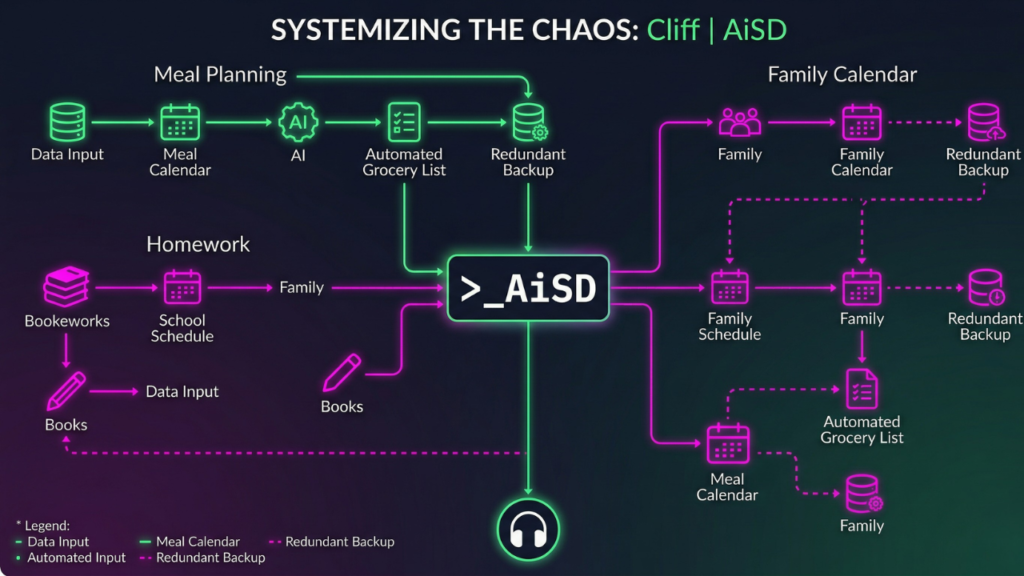
Your AI-powered parenting setup might look like this: ChatGPT for weekly meal plans, Claude for homework breakdowns, DALL-E for birthday invitations, a calendar automation using webhooks (automated handshakes between apps), scheduled reminders powered by API calls (instructions sent from one app to another).
Build your family routines around one of those tools and you’ve created a dependency with no safety net. One shutdown and you’re back to square one at 7am on Monday.
The real risk here isn’t that Claude or ChatGPT disappears tomorrow. It’s that you’ve handed your family’s critical admin to a system you don’t control, without ever thinking about what happens when it changes.
What This Looks Like in Practice
Say you’ve been using Claude to break down your 10-year-old’s maths homework. The system works: upload the problem, Claude explains the concept, your kid understands, you both move on.
What if Claude was unavailable for a week?
Your backup doesn’t need to be perfect. It could be Khan Academy (free, no login, indexed by year group), a PDF from your local education authority, your own notes from the last time you helped with this topic, or your kid’s school textbook. Write that down. Laminate it if you’re feeling dramatic. You’ve just moved from tool reliance to tool convenience.
That distinction matters. Reliance breaks your family when the tool breaks. Convenience just means an extra 20 minutes.
The 15-Minute Resilience Audit
Take your three most critical AI-powered routines. For each one, answer these three questions:
Can you do this without the tool if you have to? Write the honest answer. If it’s no, you have a single point of failure.
Do you have a backup plan written down? One page. “If this tool goes down, I do X instead.” Typed and saved somewhere you’d actually find it at 7am.
Are you making decisions based on what the tool outputs, or using the tool to speed up a decision you could make anyway? The first is reliance. The second is convenience.
For any routine that fails the first two questions, write a one-page backup process now. That’s your insurance policy. It takes about 15 minutes per system and you only do it once.
Reality Check
This isn’t an argument against AI tools. Sora was genuinely innovative. The people who built on it weren’t reckless. They were doing what builders do: moving fast on the latest platform.
The mistake wasn’t using Sora. It was building as if Sora would always be there.
Your family systems should use AI where it makes life measurably easier. They should also function without it.
The parents who came through the Sora shutdown aren’t the ones who never used it. They’re the ones who had a next move ready.
Key Takeaways
- AI tool shutdowns happen. Sora cost too much to run. It went away.
- Build your family routines around a single tool and you’ve created a dependency that can break overnight.
- A 15-minute audit of your three most critical AI-powered routines identifies which ones need backup plans.
- The goal is to make sure your family system functions if a tool disappears, not to avoid AI tools altogether.
- Resilient systems use AI for speed, not survival.
Found this useful? Check out the Education Hub
Cliff is an IT project management consultant and founder of Cliff AiSD. Follow on X and LinkedIn.