
I spent three years helping a high street bank migrate a critical business application from on-premises infrastructure into AWS. Global team across three time zones. Financial regulators signing off on every decision. Governance frameworks. Implementation protocols. Risk assessments.
That was tough.
But it wasn’t as tough as the parental mental load caused by being alone with twin babies at bedtime while my wife worked evenings, trying to get both of them to sleep at the same time, while making sure my eldest daughter still got the attention she needed.
The bank project had documentation. The home project had chaos.
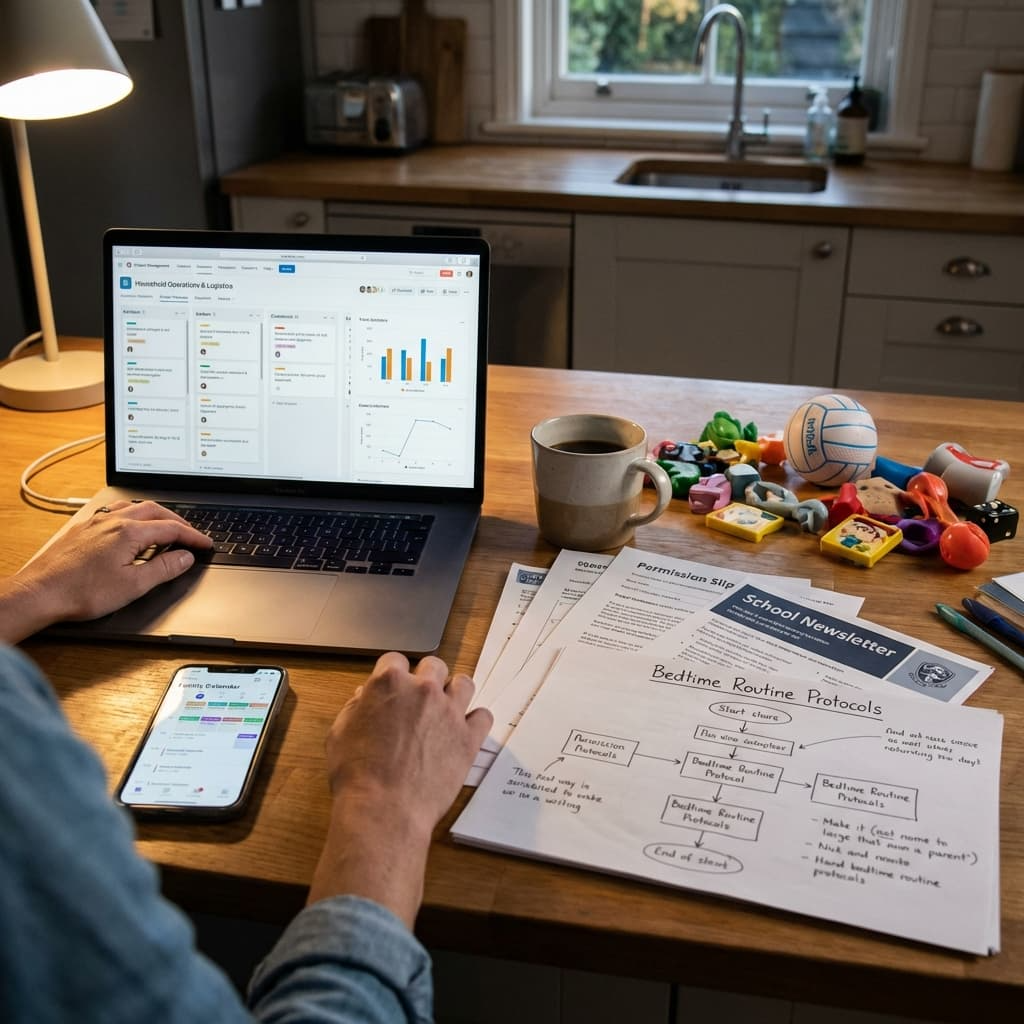
The Kitchen Moment That Changed Everything
I was standing in the kitchen. Three hungry kids. No dinner plan. No critical path to getting food on the table.
Then my daughter remembered she had netball the next evening. We hadn’t signed the permission slip.
While I was checking that out, I saw an email from school. The twins needed rain suits for forest school starting the next day.
Unread school emails piled up. Calendar notifications I’d swiped away. Website logins I couldn’t remember. Information scattered across platforms I’d never consolidated.
I felt failure. I felt guilt.
And I thought: **I would never run an enterprise project like this.**
No project manager would tolerate this level of operational chaos. No system architect would accept this fragmented information flow. No delivery manager would greenlight a production environment with this many single points of failure.
Yet here I was, trying to run a household with three kids using nothing but mental tabs and hope.
The Mental Load Isn’t Metaphorical
Research from the University of Bath analysed data from 3,000 U.S. parents and found that
mothers handle 71% of household tasks
that require mental effort. That’s 60% more than fathers, who manage just 45%.
But here’s what makes this different from physical household work: cognitive labour isn’t bound by time or space.
You can’t clock out.
It runs in the background on the way to work. During meetings. While you’re trying to sleep. The mental load operates as persistent background processing with no off switch.
A 2025 study found that invisible labor scores significantly correlated with burnout in working mothers of young children. Another study of dual-earner couples showed that women who reported doing a greater proportion of household cognitive labor experienced higher emotional exhaustion, lower career resilience, and greater intentions to quit their jobs.
This isn’t about feelings. This is about measurable cognitive resource depletion.
The Work Requires Enterprise-Level Thinking
Cognitive household labor breaks down into four distinct stages: anticipating needs, identifying options for filling them, making decisions, and monitoring progress.
That’s exactly how project managers run complex initiatives.
Yet families attempt this without any of the documentation, workflows, or systematic approaches that would be considered baseline requirements in a professional environment.
Nearly 9 in 10 women feel solely responsible for organising family schedules. At least 7 in 10 women are also responsible for maintaining standards for routines and assigning household chores.
You’re running a multi-stakeholder project with competing priorities, resource constraints, timeline dependencies, and zero documentation.
**And you’re doing it without the tools you’d demand at work.**
Why “Invisible Work” Stays Invisible
The term “invisible work” was coined in 1986 by sociologist Arlene Kaplan Daniels. She argued that this work has to stay invisible because if you valued organising a child’s schedule or managing household logistics as much as you valued an hour in the boardroom, our current societal and economic structures would collapse.
The work remains systematically undervalued despite being infrastructure-critical.
Parents often overestimate their contributions to household mental load. But fathers do this significantly more than mothers. While mothers report handling 71% of mental load tasks, fathers believe they’re managing 45%.
The work stays invisible even to the people who benefit from it.
What Happens When You Treat Home Like a Production Environment
After that kitchen moment, I started applying the same frameworks I use for cloud migrations to household operations.
I’m not running my home life on Gantt charts or change boards. That would be absurd.
But I am treating information flow, task management, and decision workflows with the same systematic care I’d apply to any production environment.
I built a ChatGPT Project that consolidates school communications, family calendar data, and household reference materials. I voice dump my mental tabs into organised action lists. I set reminders that actually close cognitive loops instead of leaving them running in background memory.
The goal isn’t to make family life corporate.
**The goal is to automate the mundane so you can spend time on what actually matters.**
Playing with the kids. Rewarding good behaviour. Quality time as a family. The parts you protect from infrastructure.
The Guilt Doesn’t Disappear
I need to be honest about something.
I’ve struggled with my mental health since the twins were born, and through the COVID pandemic. The guilt is always there in varying degrees.
I always feel bad about things I think I could do better for the kids. Situations I could have handled differently.
Building these systems didn’t make that go away.
But it did change what I have bandwidth to feel guilty about.
I’m no longer drowning in logistics guilt. I’m not beating myself up for forgetting permission slips or missing school emails or showing up unprepared.
The systems handle the operational layer. That frees up cognitive space for the parts of parenting that actually require human judgment, emotional presence, and attention.
What Enterprise IT Taught Me About Parenting
Here’s what I learned from running that bank migration that applies directly to home management:
Documentation beats memory. If it’s not written down, it doesn’t exist. Your brain isn’t a reliable storage system for operational details.
Automation is respect for attention. Every repeated manual task is a failure of architecture. If you’re doing it more than twice, you should be automating it.
Single points of failure are unacceptable. If only one person knows where the rain suits are or what time netball starts, your system is fragile.
Cognitive load management is infrastructure work. You can’t perform well when you’re context-switching between dozens of mental tabs. Close the loops.
Verification always matters* I learned this when ChatGPT went down globally and I couldn’t access a to-do list. Now I always copy-paste into a dedicated to-do app. Trust the system, but build redundancy.
The Line Between Systems and Over-Engineering
You might be thinking this sounds cold. Robotic. Like I’m turning my family into a corporate project.
Here’s the line I draw:
Systems thinking creates relief when it captures incoming communications so the family calendar stays current and the fridge has tomorrow night’s dinner ingredients ready.
It becomes over-engineering when you’re building workflow diagrams for bedtime routines or running retrospectives on weekend activities.
The difference is intent.
I’m not optimising for optimisation’s sake. I’m building infrastructure that reduces friction in the mundane so more time and energy flow toward the meaningful.
The systems exist to create space for spontaneity, not eliminate it.
What I Haven’t Systematised
There are parts of home life I’ve consciously decided to leave unoptimsed.
Dealing with behaviour. Rewarding good moments. The quality time spent as a family that automating the mundane should enable.
Those stay messy. Those stay human.
Because the point of building infrastructure isn’t to make everything systematic.
The point is to clear space for the things that should never be systematised.
The Realisation
Managing a home is harder than any corporate project I’ve run because you’re doing enterprise-level cognitive work without enterprise-level tools.
You’re running multi-stakeholder coordination across competing priorities with zero documentation and no systematic approach.
You’re expected to hold dozens of mental tabs open simultaneously while also being emotionally present, physically available, and making real-time decisions that affect the people you care about most.
And you’re doing all of this while society tells you the work should be invisible.
The bank migration had governance frameworks, risk assessments, and regulatory sign-off.
The home project has unread emails, forgotten permission slips, and rain suits you didn’t know you needed.
One of these got treated like infrastructure-critical work.
The other one should.
Found this useful? Check out my other guides and blogs below
Originally posted 2026-01-29 23:28:28.